Whether you plan to sell your firm in the next few years or want to create a stronger, more profitable practice for the future, boosting EBITDA (Earnings Before Interest, Taxes, Depreciation, and Amortisation) is key. A steady rise in EBITDA not only improves day-to-day performance but also makes your firm more attractive to buyers. In fact, a healthier EBITDA usually means a higher valuation and a much easier exit. Here’s a practical guide, updated with fresh insights from the industry.
Key Takeaways
- EBITDA is the core driver of practice value: Stronger, more predictable EBITDA leads to higher valuations and better exit opportunities.
- Systemisation and technology dramatically increase profitability: Cloud tools, automation, and standardised workflows reduce costs, boost efficiency, and make firms more attractive to buyers.
- Recurring revenue and advisory services raise long-term firm value: Predictable income streams and higher-margin services like virtual CFO support significantly improve valuation multiples.
- Reducing owner-dependency strengthens resilience and saleability: A firm that operates smoothly without the founder commands higher interest and confidence from lenders and buyers.
- Client retention, diversification, and strong branding are essential for growth: Firms with low churn, no single client dependence, and clear market positioning achieve higher multiples.
- Exit planning should start years in advance: Clean financials, documented processes, and a stable team make due diligence smoother and maximise buyer confidence.
Why EBITDA & Exit Planning Matter
- Growth is strong across the profession: A recent UK survey found that 79% of accountancy firms reported revenue growth in the past 12 months, while 74% also saw profit increases. Much of this momentum is attributed to practices embracing digital tools and diversifying into advisory and value-added services. (1)
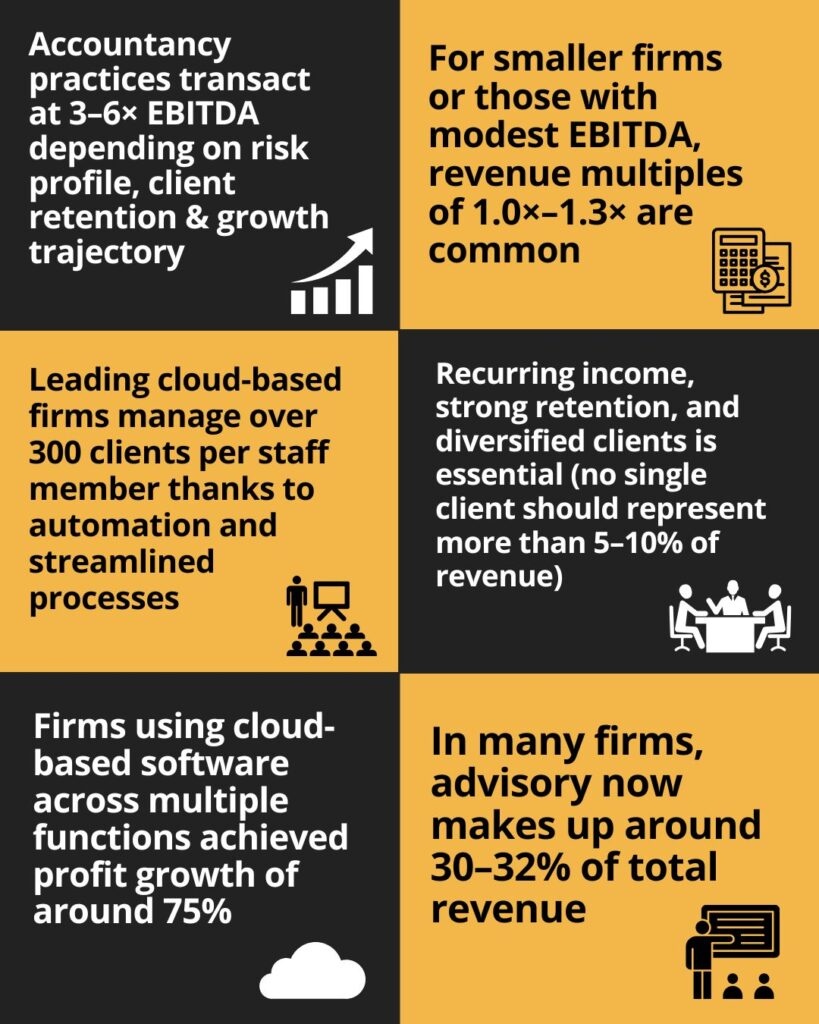
- Technology drives profitability: Firms using cloud-based software across multiple functions achieved profit growth of around 75%, compared to just 39% for firms using digital tools in a single area. This reinforces the link between end-to-end digital adoption and sustainable EBITDA uplift. (2)
- Automation and AI are reshaping the market: According to Intuit’s industry research, 95% of firms now use automation technologies, 79% expect advisory work to expand, and 81% say AI tools have already boosted productivity. This trend is expected to accelerate, further improving margins and valuation multiples. (3)
- EBITDA links directly to valuation: Industry guidance shows that predictable earnings, recurring revenue, and well-documented processes lead to higher multiples with typical accountancy practice valuations ranging from 3.0x to 4.5x EBITDA, depending on risk profile, client retention, and growth trajectory. (4)
What this means for you: When a firm’s earnings are predictable, scalable, and not overly reliant on the owner, both EBITDA and valuation multiples rise. Buyers will consistently pay a premium for practices with recurring revenue, strong systems, growth visibility, and low perceived risk.
How to Grow EBITDA & Practice Value
Here’s a clear, data-driven plan to help you improve margins, grow long-term value, and stay in a strong position even if you don’t plan to sell your practice for years.
Grow Recurring Revenue & Client Value
- Advisory is catching up with compliance: In many firms, advisory now makes up around 30–32% of total revenue. It’s nearly on par with bookkeeping but offers better margins. (5)
- Predictable income boosts valuations: Firms with fixed-fee or retainer models enjoy steadier cash flow, and that reliability often leads to stronger EBITDA multiples. While the average multiple is 3.0×–4.5×, firms with high recurring revenue usually achieve higher valuations.(5)
You can read more about adding value with new services here.
Make Operations Leaner
- Digital-first pays off: Firms using cloud software across multiple areas reported profit growth of 75%, compared with 39% when it was used for only one function.(6)
- Automation is standard: By 2025, 95% of firms are using automation, and 81% say AI has improved productivity. Full automation cuts manual work, reduces errors, and lowers cost per client.(7)
You can read more about implementing AI in your firm here.
Scale with Smart Teams
- Efficiency at scale: Leading cloud-based firms manage over 300 clients per staff member thanks to automation and streamlined processes.
- Flexible staffing: Outsourcing, remote teams, and standardised workflows help reduce overheads while supporting growth.
You can read more about managing your team as it grows here.
Cut Unnecessary Costs
- Watch out for “subscription creep”: Many practices pay for unused licences. Bringing accounting, payments, and banking into one system reduces waste and increases efficiency.
- Simplify your tech stack: Too many disconnected apps mean higher licence fees and extra training. A slimmed-down toolkit helps both margins and staff productivity.
You can read more about streamlining operations here.
Focus on the Right Clients
- Specialisation pays off: Firms that focus on industries or high-value advisory services earn more revenue per employee.
- Review your client list: Low-paying, high-maintenance clients drain profits. Repricing or letting them go strengthens margins.
You can read more about exploring niche markets here.
Build a Strong Brand & Marketing System
- Clear positioning drives growth: Firms with a strong brand, positive reviews, and thought leadership attract higher-value clients who prefer retainers or fixed fees.
- Digital-first clients are better clients: Practices with clients who actively use cloud tools grow faster and stay longer.
You can learn more about building the right brand here.
Protect Your Margins
- Contracts matter: Engagement letters, clear scope management, and charging for extra work keep margins steady and reduce write-offs.
- Cash flow discipline: Automated reminders, direct debit, and tighter credit control reduce debtor days and strengthen working capital.
Measure What Counts
Key benchmarks to monitor in firms:
| Metric | What Benchmark Data Shows | Source |
|---|---|---|
| Client growth | Average 31 new clients per practice in the past 12 months | (8) |
| Revenue mix | Advisory revenue contributes 30–32%, growing faster than compliance | (9) |
| Cloud adoption depth | Firms using cloud for multiple tasks report 75% profit increases, vs 39% for single-task use | (10) |
| Revenue per employee | Advisory-heavy, niche practices significantly outperform average benchmarks | (11) |
Firms that embrace recurring revenue, digital efficiency, niche positioning, disciplined client management, and regular financial tracking consistently achieve stronger EBITDA. Higher, more sustainable earnings naturally translate into better valuation multiples.
Exit Strategies for Accountants
Once your EBITDA is stable and growing, an exit becomes viable. But many practice owners underestimate the time, effort, and complexity involved in getting there. Industry data shows that succession planning is often left too late, and this can significantly reduce both value and options. Using external benchmarks to guide your timing, valuation, and structure helps avoid costly surprises.
Understand Your Exit Options
Common exit routes include trade sales, mergers, private equity investment, management buy-outs, internal succession, or sales to junior partners. Each path carries different risk, tax, and timing implications. For example, many buyers expect the owner to remain 2–3 years post-sale to ensure client retention and continuity. Industry research warns that too many practitioners delay succession planning, narrowing their choices and eroding value. Source
Get a Practice Valuation
- EBITDA multiples: Typical accountancy practices transact at 3.0×–4.5× EBITDA, depending on factors such as size, recurring revenue, client concentration, and growth trajectory. High-performing firms with stable income, digital systems, and low owner dependency often exceed this range. (12)
- Revenue multiples: For smaller firms or those with modest EBITDA, deals may still use revenue multiples of around 0.7×–1.0× annual fees. Firms with higher advisory income, client stickiness, and benchmarking discipline command premium valuations.
- Valuation complexity: ICAEW highlights that multiples vary by earnings sustainability, growth prospects, and risk profile, making professional valuation essential. (13)
Prepare for Buyer Due Diligence
Buyers will scrutinise every aspect of your practice. Preparation includes:
- Clean, accurate, and preferably audited financials, with business and personal expenses clearly separated.
- Standard operating procedures (SOPs), documented workflows, defined staff roles, and signed client contracts.
- Evidence of recurring income, strong retention, and diversified client base (ideally, no single client should represent more than 5–10% of revenue).
- Digital maturity: Paperless systems, cloud adoption, and automation are now baseline expectations. Firms still reliant on manual processes face heavy buyer discounts. (14)
Reduce Key Person Dependency
If the business relies too heavily on the owner for sales, delivery, or reputation, buyers will apply a steep discount. Building a leadership team, delegating responsibilities, and transferring client relationships are essential to protecting value. (15)
Plan the Transition
Decide in advance whether you want a clean break or to remain on as a consultant/partner post-sale. Most successful transitions last 12–24 months, with successors groomed early to reassure both clients and staff. This reduces perceived buyer risk and smooths cultural integration.
Bring in the Right Advisors
Expert guidance pays for itself. Engage:
- M&A specialists or brokers with experience in professional services.
- Tax advisors to structure the sale efficiently.
- Legal counsel for contracts, leases, and employee matters.
- A financial planner to ensure exit proceeds align with your personal goals.
A well-prepared practice with predictable EBITDA, low risk exposure, digital maturity, and clear succession planning is not only more attractive to buyers but also commands a premium valuation multiple.
Grow With the End in Mind
You don’t have to wait until you want to sell to start building toward an exit. Many of the levers that increase your EBITDA, resilience, and value also make your practice more profitable, enjoyable, and less risky today.
- Focus on predictable, recurring revenue streams
- Apply technology to eliminate waste and standardise delivery
- Build scalable teams and systems
- Niche intelligently and strengthen your brand
- Monitor key metrics rigorously
When you do plan your exit, having those foundations in place means buyers see less risk, you can negotiate from strength, and your multiple is likely to be materially higher.
Download the Workbook
In the workbook below, you’ll map out the key priorities, actions, and milestones that will guide your firm’s growth over the coming years. You’ll translate your vision into clear decisions about capacity, operations, technology, revenue, and risk — creating a structured plan you can execute and refine over time.

Download the Long-Term Growth Workbook
Bibliography
- https://www.xero.com/us/campaign/accounting-industry-report/
- https://www.xero.com/us/campaign/accounting-industry-report/
- https://quickbooks.intuit.com/global/resources/accounting/ebitda-and-ebitda-formula/
- https://www.accaglobal.com/uk/en/member/sectors/smp/shaping-your-practice-exit/planning-your-exit/multipliers.html
- https://www.cpai.com/Education-Resources/my-firm/Firm-Acquisitions-Transitions/A-Guide-to-Maximize-Your-CPA-Firm-Sale
- https://www.xero.com/us/campaign/accounting-industry-report/
- https://quickbooks.intuit.com/global/resources/accounting/ebitda-and-ebitda-formula/
- https://www.xero.com/us/campaign/accounting-industry-report/
- https://www.accaglobal.com/content/dam/ACCA_Global/Technical/Reports/ACCA%20Singapore_Professional%20Services.pdf
- https://www.xero.com/us/campaign/accounting-industry-report/
- https://www.cpapracticeadvisor.com/2017/12/06/advisory-services-take-off-as-revenue-channel-for-accounting-firms/
- https://www.cpai.com/Education-Resources/my-firm/Firm-Acquisitions-Transitions/A-Guide-to-Maximize-Your-CPA-Firm-Sale
- https://www.icaew.com/library/company-research/private-company-multiples
- https://www.accaglobal.com/uk/en/member/sectors/smp/shaping-your-practice-exit/planning-your-exit.html
- https://www.practiceweb.co.uk/
About the Author

Neha Jain
Neha Jain is a skilled content writer with a rich background in business and financial knowledge. With a bachelor’s degree in English Literature and Psychology, Neha has honed her writing skills, furthering her expertise with the Content Writing Master Course (CWMC) at IIM SKILLS and a Content Marketing Certification from HubSpot Academy.
Working alongside our business development experts, Neha specialises in helping accountants, dentists and other healthcare professionals start, scale and sell their businesses.
Reviewed by

Arun Mehra
Samera CEO
Arun, CEO of Samera, specialises in building global accounting businesses.
Arun is a recognized authority on offshoring and Global Capability Centers (GCCs), having built a global team with locations in the UK and India. He helps other accounting firms leverage offshoring to access global talent, improve efficiency, and future-proof their operations.